What we are building
Projects in progress.
Work that is underway rather than finished. We would rather show you what is being built and where it stands than wait until there is a ribbon to cut.
Fly ash · Nava, Coahuila → Eagle Pass, Texas
Fly ash beneficiation plant
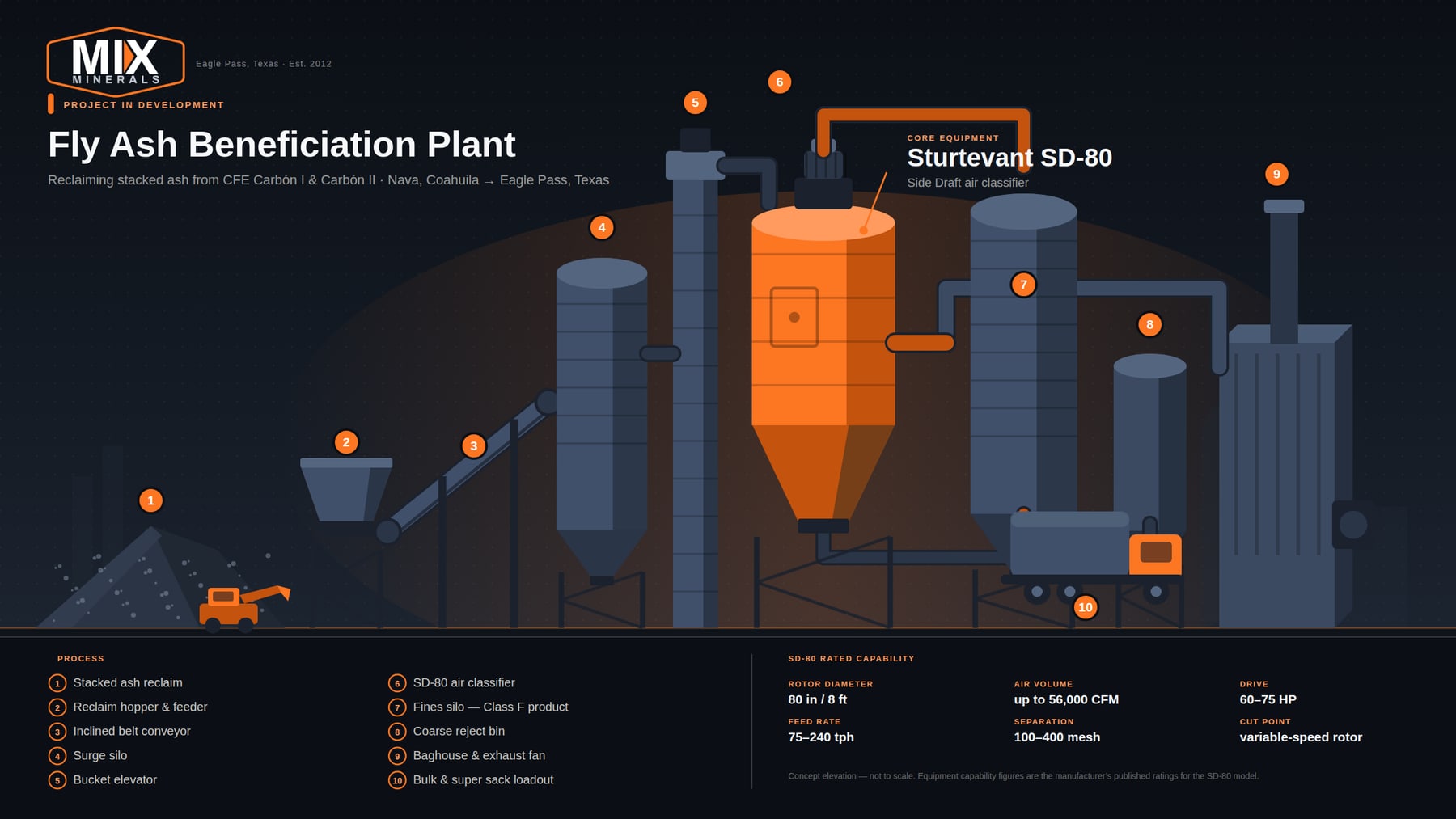
A processing plant that reclaims stacked ash from the CFE Carbón I and Carbón II stations in Nava, Coahuila and classifies it into a fine, low-carbon Class F product — built around a Sturtevant SD-80 Side Draft air classifier.
Why stacked ash, and why classify it
The ash going into this plant is not fresh production off a precipitator. It is ash that was stacked — placed in a managed pile over decades, when there was no market for it. Two CFE stations in Nava, Coahuila are the source.
Stacked ash is not uniform. It was never classified on the way in, so a single pile holds everything from fine spherical particles to coarse material carrying unburned carbon. Sold as it lies, it is a fill material. That is the whole problem the plant exists to solve.
Air classification splits that pile by particle size. The fine fraction is the part that behaves as a supplementary cementitious material — spherical, pozzolanic, and low enough in carbon to be usable in concrete. The coarse fraction is where the unburned carbon concentrates, and it leaves as a separate stream instead of contaminating the product.
The carbon problem, stated plainly
Unburned carbon is what makes fly ash unpredictable in concrete: it adsorbs air-entraining admixture, so dosage stops behaving, and it is what loss on ignition actually measures. Because that carbon rides on the coarser particles, a size cut is also a carbon cut. This is not a chemical treatment and we will not describe it as one — it is separation, and what it can and cannot do is bounded by what is in the feed.
Where the ash comes from
Two CFE coal-fired stations on one site in Nava, Coahuila — about 33 km from Eagle Pass, one border crossing away.
Carbón I — José López Portillo
Four 300 MW units, in service since 1982–1987. Over forty years of ash.
Carbón II
Four 350 MW units, in service since 1993–1996.
Both stations belong to Comisión Federal de Electricidad and both burn bituminous coal out of the Micare mine, in the Fuentes–Río Escondido basin. Together they are 2,600 MW of coal-fired generation sitting closer to Eagle Pass than most Texas ash sources are to their own customers.
The coal type is not a detail. ASTM C618 splits fly ash into Class F and Class C largely on the fuel behind it: Class F comes from bituminous and anthracite coal, Class C from lignite and sub-bituminous. These units burn bituminous, which is why the material out of this stack is a Class F candidate on chemistry rather than on hope.
And because the feed is a stack rather than a live precipitator, supply does not depend on whether a unit happens to be running this week. Decades of ash are already on the ground. That is the difference between reclaiming and taking allocation.
None of this makes the material certified. The coal type tells you what class it can be; only testing and the certifications listed below tell you what it is.
How the plant runs
- 01
Reclaim
Ash is worked off the stack face and fed to a receiving hopper.
- 02
Conveying & surge
An inclined belt feeds a surge silo, which buffers the classifier against an uneven reclaim rate.
- 03
Elevation
A bucket elevator lifts feed to the classifier inlet.
- 04
Classification
The SD-80 disperses the feed into a rising air stream. The rejector cage returns coarse particles; fines pass through.
- 05
Product & reject
Fines go to the product silo. Coarse material — carrying the carbon — goes to a separate bin.
- 06
Dust control
A baghouse and exhaust fan close the air circuit; collected fines return to product.
- 07
Loadout
Pneumatic bulk tanker and super sack, the same way we ship everything else.
What it means if you buy fly ash from us
- A second source of Class F in a market where availability has tightened as coal generation has retired.
- Product from a stack we control, rather than allocation from a station that may or may not be running.
- Classification on site, which means the fineness that leaves here is a setting we can hold, not a property we hope the feed happens to have.
Where it stands
Feedstock secured
Stacked ash from CFE Carbón I and Carbón II, Nava, Coahuila.
Classifier selected
Sturtevant SD-80 Side Draft.
Plant construction
In progress.
Commissioning & baseline testing
Establishing what the source actually yields.
ASTM C618 certification
In process.
TxDOT Material Producer List
In process — required for state work in Texas.
Certification status
Our ASTM C618 certification and the TxDOT Material Producer List approval for this source are in process, not in hand. Until they are issued, we are not offering this material for work that requires either one. We would rather say that here than have you find out on a submittal.
Want to be told when it comes online?
Tell us the volume and the spec you would need, and we will come back to you when the plant is commissioned and the certifications are issued — not before.
Talk to us about fly ash →